
A FREE COOKBOOK FOR THE SINGLE LIFE
Cooking for one.
A table worth
preparing for.
Make something good with the life in front of you. Enjoy 28 Dunn family recipes, practical help for cooking for one, and biblical encouragement for your everyday table.
Free PDF · Recipes and reflections
By Dr. PJ Dunn & Family
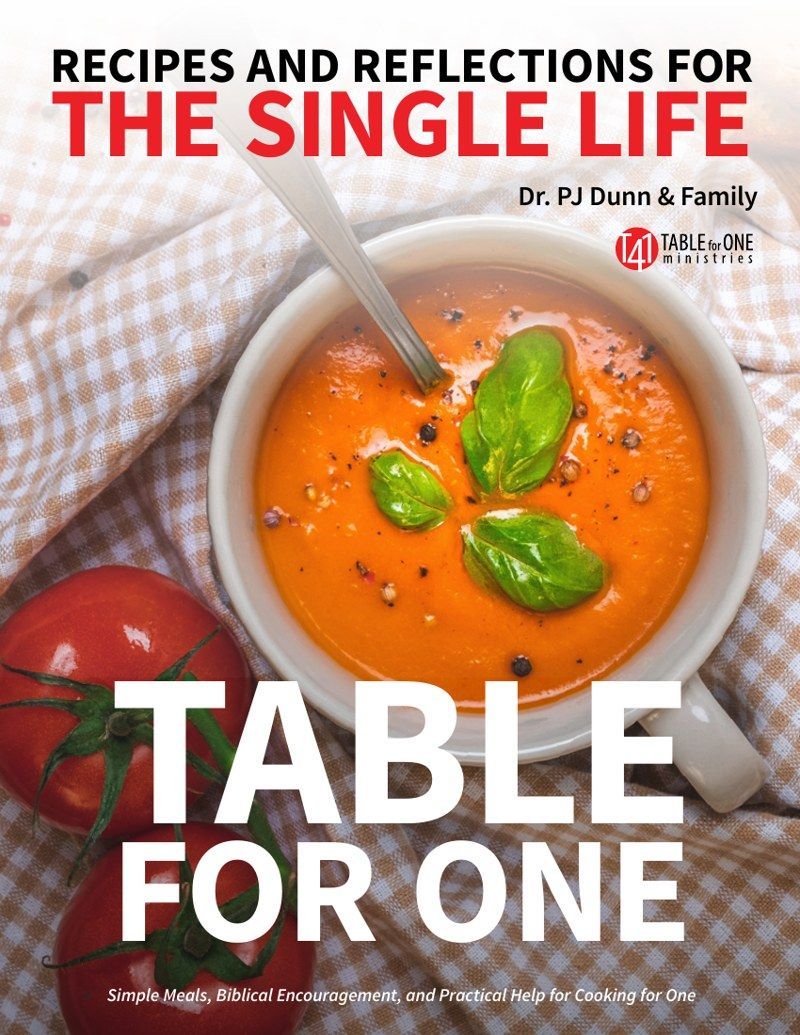
Read on your phone, tablet, or printed pages.
Receive your free copy.
Download the complete cookbook and receive a backup link by email.
28 family recipes. Six sections.
Encouragement for your everyday table.
Free Cookbook
FROM OUR FAMILY TABLE TO YOURS
Try a recipe. Stay for the reflection.
Choose a meal from each of the cookbook’s six sections. Open the recipe when you’re ready to cook, or take a few minutes with its Scripture reflection.
FEATURED FAMILY RECIPE · FOR THE TABLE
Mommaw’s Goulash
An original Dunn family recipe for a shared table, a community meal, or planned leftovers. This family favorite serves four.
PAIRED REFLECTION
A Faith Worth Passing Down
Psalm 145:4 (ESV)
View recipe
Serves: 4 servings Time: About 40 minutes
Ingredients
• 1 pound hamburger
• 1 can of condensed tomato soup
• 1 cup ketchup
• 1 onion, chopped
• 1/2 bell pepper, chopped
• 1 tablespoon vinegar
• 1 tablespoon brown sugar or white sugar
• 1 teaspoon garlic powder
• 1 tablespoon mustard
• 8 ounces egg noodles, cooked to package directions
• Parmesan cheese
• Saltine cracker crumbs, about 10 crackers
Instructions
1. In a skillet, brown meat with onion and pepper over medium-high heat until the meat is no longer pink.
2. Add the remaining ingredients to the noodles.
3. Spray a 2-quart casserole dish or 9 x 13-inch pan with cooking spray.
4. Add goulash.
5. Top with cheese and cracker crumbs.
6. Bake for 25 minutes at 350 degrees F.
Variations and Options
• This serves 4, making it better for potluck, community meals, or planned leftovers.
• Divide leftovers into single portions for later meals.
• Serve with a simple salad or green beans.
Single-Friendly Note
This original Dunn family recipe serves four. Use it for a community meal or freeze cooled leftovers in labeled single portions.
Food safety: Cook ground beef to an internal temperature of 160° F.
Read the reflection
Scripture Focus: Psalm 145:4 (ESV)
A recipe with a family name carries more than measurements. It holds memory, affection, regional habits, and the ordinary generosity of people who fed whoever arrived. Mommaw’s Goulash remains a four-serving dish because some recipes are not meant to be reduced. They are made for a gathering, for planned leftovers, or for a container to be carried to someone else.
Faith also moves through generations, but it is never inherited automatically. One generation commends the works of God to another through words and lives that point beyond themselves. Family can be part of that witness, and the church becomes a spiritual family in which believers of all relationship statuses participate.
Single adults have legacies. The absence of a spouse or biological children does not preclude investing in people, shaping a church, mentoring younger believers, supporting families, telling the truth, preserving stories, and modeling obedience. The kingdom of God measures fruit by faithfulness, not by whether a family tree looks conventional.
Make the goulash when there are people to feed, or divide it into portions for the freezer. Tell the story connected to the name. Then ask what story your life is telling about God. The most valuable legacy is not a polished image or a famous name. It is a life that helps another generation see the Lord’s faithfulness and learn to trust Him.
Practice
Record one family or faith story before its details disappear. Include the people, place, lesson, and evidence of God’s faithfulness without polishing away every difficulty. Share it with someone younger or add it to a recipe card. Honest stories help another generation see that faithfulness is lived by real people in real circumstances. The story matters because it directs attention beyond the family name to the Lord.
Takeaway
Every believer can leave a spiritual legacy by commending God’s faithfulness to people who come after them.
For Reflection or Conversation
1. What story of God’s faithfulness should you preserve and share?
2. Who could receive intentional encouragement or mentoring from you?
Prayer
Lord of every generation, make my life a truthful witness to Your faithfulness. Help me preserve what matters and invest it generously in people who will carry the gospel forward. Amen.
SOUPS
Tomato Basil Soup
A simple bowl of soup for an ordinary evening. Pair it with half a sandwich or a small salad.
PAIRED REFLECTION
Care in the Ordinary
Matthew 6:33 (ESV)
View recipe
Serves: 1 serving
Time: About 15 to 20 minutes
Ingredients
• 1/4 cup chopped onion
• 1 tablespoon olive oil or butter
• 1 15-ounce can of tomato sauce
• 1 bouillon cube, beef or chicken, or 1 teaspoon bouillon base
• 1 teaspoon dried basil
• 1 chopped garlic clove or 1/2 teaspoon garlic powder
• Salt and pepper to taste
Instructions
1. In a saucepan, cook chopped onion in butter or oil over medium heat until slightly browned, 5 to 7 minutes.
2. Add tomato sauce and bouillon, stirring until the cube is dissolved.
3. Simmer on low for 5 to 10 minutes.
4. Stir in basil and garlic.
5. Add salt and pepper to taste and serve.
Variations and Options
• Add 1/4 teaspoon cayenne or red pepper flakes for spice.
• Add 1 cup of washed, chopped fresh spinach leaves when adding the sauce.
• Use chopped tomatoes, undrained, for a chunkier soup.
• Add 1/2 teaspoon of curry powder or Italian seasoning to vary the flavor.
• Add chopped cooked chicken, turkey, ham, ground beef, or beans for protein.
• Add 2 to 3 tablespoons of evaporated milk, milk, or cream for a creamier soup
Single-Friendly Note
Pair the soup with half a sandwich or a small salad. Freeze any extra tomato sauce in a labeled single-use portion.
Read the reflection
Scripture Focus: Matthew 6:33 (ESV)
Cooking for one can expose how easily we divide life into important things and ordinary things. We make room for work, ministry, appointments, and other people, but we treat the meal in front of us as an interruption. A bowl of soup seems too small to matter. Yet Jesus never taught His followers to wait for a different relationship status before living faithfully. He called people to seek the kingdom of God in the life they had already been given.
That changes the meaning of an ordinary kitchen. Preparing one bowl of tomato basil soup is not a dramatic act, and it need not be. It is a practical way to receive the day God has given, care for the body He created, and practice gratitude without needing an audience. A Table for One is not an empty table when Christ is present. It can become a quiet place of prayer, nourishment, and attention.
Single adults are often highly capable. We learn to solve problems, manage schedules, and keep life moving. That strength is useful, but it can also tempt us to believe that care only counts when it is offered to someone else. Scripture gives a fuller picture. Loving our neighbor does not require neglecting wise stewardship of our own lives. Rest, food, prayer, friendship, service, and community all belong under the lordship of Christ.
As the soup simmers, let its simplicity slow the pace for a few minutes. Thank God for what is available rather than measuring the meal against what is missing. If someone comes to mind, send a message or share the recipe. Ordinary faithfulness rarely looks impressive, but God has always done meaningful work through people who place common moments in His hands.
Practice
Choose one meal this week to eat without a screen or a rushed agenda. Set the table, even if the setting is simple. Begin with prayer, pay attention to the food, and let the quiet become an opportunity to listen to the Lord. This is not a rule for earning spiritual credit. It is a small way to resist treating your life as disposable and to receive an ordinary moment as part of faithful discipleship.
Takeaway
One person is worth the time it takes to prepare something good, and ordinary care can be offered to God as an act of faithful stewardship.
For Reflection or Conversation
1. Where have you been treating your present life as a waiting room?
2. What ordinary practice could become an act of gratitude this week?
Prayer
Lord, teach me to receive the life You have given today. Make me faithful in ordinary care, grateful for Your provision, and attentive to the people You place near my table. Amen.
MAIN DISHES
Chicken Tacos
Two tacos for tonight, with room to make the toppings your own. Keep unused toppings separate for another meal.
PAIRED REFLECTION
Hospitality Without a Show
Romans 12:13 (ESV)
View recipe
Serves: 1 serving, 2 tacos
Time: About 15 minutes
Ingredients
• 1 tablespoon olive oil or butter
• 4 ounces chicken, cut into bite-sized pieces, roughly half a breast or one thigh
• 1/4 cup chopped onion
• 1/4 bell pepper, chopped, any color
• 1/4 teaspoon cumin
• 1/8 teaspoon salt
• 1/4 teaspoon chili powder
• 1/4 to 1 teaspoon red pepper flakes
• 2 hard taco shells or tortillas
Instructions
1. In a skillet, heat oil or butter on medium-high.
2. Add chicken, onion, and pepper.
3. Stir occasionally and cook for 7 to 8 minutes until the chicken is no longer pink.
4. Add spices and remove from heat.
5. Divide among 2 shells or tortillas.
Variations and Options
• Add shredded lettuce or cabbage, chopped tomatoes, shredded cheese, sliced avocado, jalapeños, cilantro, drained canned corn, raw onion or peppers, sour cream, salsa, ranch dressing, picante sauce, or salsa verde.
• Corn or flour tortillas can be used; however, corn tortillas taste especially good and are more pliable when warmed.
Single-Friendly Note
Prepare only two tacos for the meal, then refrigerate unused toppings separately so they stay useful for another dish.
Food safety: Cook chicken to an internal temperature of 165° F.
Read the reflection
Scripture Focus: Romans 12:13 (ESV)
Hospitality is easy to postpone until the house is larger, the furniture matches, or the meal feels impressive. Scripture presents something warmer and more demanding. Hospitality is a practice of making room. It is not a performance built around a perfect table. It is the willing use of what God has placed in our hands for the good of another person.
Tacos are helpful because they resist formality. Two tortillas, a skillet, and a few toppings can become dinner for one or expand quickly when someone joins you. The food does not need to last the whole evening. Conversation, attention, and welcome do more of that work than an elaborate menu ever could.
Single adults can be powerful practitioners of hospitality. We know what it feels like to enter spaces organized around families and wonder where we fit. That awareness can help us notice the college student far from home, the newly divorced adult rebuilding routines, the widow facing a quiet weekend, the single parent with limited time, or the married neighbor who also needs friendship. Your table does not have to be large to make room.
Begin without turning hospitality into another exhausting project. Invite one person and ask that person to bring a topping. Use paper napkins if that helps. Leave the unfolded laundry in another room and let the evening be human. The point is not to prove that single life is full; the point is to live the love of Christ in the life He has given. A simple meal can say, sincerely, that someone has been noticed and that there is room for that person here.
Practice
Think of one person who might welcome an uncomplicated invitation. Offer a specific day rather than saying you should get together sometime, and let the person know the meal will be simple. If opening your home is not possible, meet at a park, a church table, or an inexpensive restaurant and offer the same attentive welcome. Hospitality is a posture before it is a location.
Takeaway
Hospitality begins with making room for a person, not producing an impressive experience.
For Reflection or Conversation
1. What standard of perfection has kept you from inviting someone in?
2. Who may need the simple gift of a place at your table?
Prayer
Lord Jesus, You welcomed me by grace. Free me from performing, open my eyes to the person who needs room, and make my ordinary hospitality sincere and generous. Amen.
SIDE DISHES
Green Bean Bundles
A little extra care for a familiar side dish. Make one bundle for your plate or several for a shared meal.
PAIRED REFLECTION
Small Acts, Wholehearted Service
Colossians 3:23 (ESV)
View recipe
Serves: 1 serving
Time: About 20 minutes
Ingredients
• 15 to 20 whole green beans, fresh or frozen and thawed
• 1 bacon slice
• Salt and pepper
Instructions
1. Coat an oven-safe dish with cooking spray.
2. Make a round bundle with the beans in one hand.
3. Wrap the raw bacon slice in a spiral around the beans.
4. Tuck the ends underneath as you place it on the dish.
5. Sprinkle with salt and pepper.
6. Bake in a preheated oven at 350 degrees F for 15 to 20 minutes until bacon is crispy.
Variations and Options
• Serve beside soup, fish, chicken, or a baked potato.
• Use turkey bacon if preferred.
• Add a light sprinkle of garlic powder before baking.
Single-Friendly Note
Make exactly one bundle per plate, or assemble several at once when preparing a meal to share.
Read the reflection
Scripture Focus: Colossians 3:23 (ESV)
Some acts of service are visible enough to be celebrated. Most are not. They are the chairs placed before anyone arrives, the message sent after a difficult week, the child picked up on time, the prayer offered by name, and the plate washed when the room is already empty. Scripture calls believers to wholehearted work because the true audience is the Lord.
Green bean bundles require a little more attention than placing vegetables in a pan. One bundle is gathered, wrapped, and set in place. The result is still a side dish, not the center of the meal, but care has made it distinct. Service often works that way. A small task becomes meaningful when love and faithfulness are brought to it.
Single adults frequently serve churches in ways that are both substantial and assumed. Flexible schedules are sometimes imagined where none exist, and willingness can become an invitation for endless responsibility. Wholehearted service does not mean having no limits. Jesus is Lord of our yes and our no. Healthy service is offered from identity in Christ, not as a strategy to earn belonging.
Choose one act of service and do it well. Let someone else carry another part. Receive thanks without pretending the work cost nothing, and rest without guilt when you need it. The body grows when every member contributes, not when a few members quietly carry everything. God sees the side work as clearly as the center stage, and faithfulness offered to Him is never wasted.
Practice
Review the places where you currently serve and sort them into three groups: responsibilities God has clearly given, opportunities you freely enjoy, and obligations sustained mainly by guilt. Pray over the list and discuss it with a mature believer. Continue serving wholeheartedly, but release or reshape one responsibility that prevents healthy faithfulness in the rest of your life.
Takeaway
Small acts matter when they are offered to Christ, but faithful service also honors the limits He has given.
For Reflection or Conversation
1. What unnoticed act of service has God placed in front of you?
2. Where do you need a faithful boundary so that service does not become resentment?
Prayer
Lord, receive the work that others may never see. Give me a willing heart, healthy limits, and joy in serving You rather than performing for approval. Amen.
DESSERTS
Chocolate Cake
A small chocolate cake for a moment worth marking. Made in a microwave-safe two-cup dish.
PAIRED REFLECTION
Celebrate the Life God Gave
Ecclesiastes 3:12–13 (ESV)
View recipe
Serves: 1 serving
Time: About 5 minutes
Ingredients
• 1 egg
• 1 1/2 tablespoons vegetable oil
• 3 tablespoons unsweetened applesauce, get a snack pouch at the grocery store
• Pinch of salt
• 2 1/2 tablespoons cocoa powder
• 1/8 teaspoon baking soda
• 1 tablespoon sugar or honey
• 1/8 teaspoon vanilla
Instructions
1. Beat the egg in a bowl.
2. Mix in other ingredients.
3. Spray a 2-cup microwave-safe dish with cooking spray.
4. Pour in batter.
5. Microwave for 2 minutes.
Variations and Options
• Top with chocolate chips, nuts, fresh or dried fruit, whipped cream, caramel, or peanut butter.
• Add half a banana to the batter, with or without the cocoa powder.
Single-Friendly Note
Use a microwave-safe two-cup dish and stop cooking when the center is set; extra time can make a small cake dry quickly.
Read the reflection
Scripture Focus: Ecclesiastes 3:12–13 (ESV)
Celebration is often pictured as a crowded room. That can be wonderful, but it can also leave single adults believing that joy belongs to group photographs and major milestones. Ecclesiastes offers a more grounded vision: receive the ability to eat, drink, work, and enjoy good as a gift from God. Joy is not limited to a particular household arrangement.
A cake made for one does not compete with a birthday cake surrounded by candles. It serves another purpose. It allows a small moment to be marked without creating a dessert that lingers for a week. Maybe the occasion is a completed project, a hard conversation handled faithfully, a quiet answer to prayer, or simply the goodness of an ordinary Tuesday.
Celebration should not become denial. Some days include grief, disappointment, or an empty place at the table. Christian joy can tell the truth about those realities because its foundation is deeper than mood. We rejoice in the Lord, receive His gifts, and remain honest about what hurts. Gratitude and lament are both forms of faith when they are brought to God.
Make the cake when there is something to mark, and sometimes make it because life itself is worth receiving. Call a friend if you want company. Sit quietly if you need rest. The single life is not preparation for the real celebration later. It is a real life in which God is already present, His mercies are already new, and His people already have reason for joy.
Practice
Create a short list of mercies from the last month, including answers to prayer, strength for difficulty, people who showed up, and ordinary things that brought delight. Choose one to mark intentionally. Celebration may mean sharing dessert, taking a walk, writing a thank-you note, or simply pausing long enough to recognize that grace was present.
Takeaway
Joy belongs in the present because life with God is already real, even when gratitude and grief occupy the same day.
For Reflection or Conversation
1. What quiet evidence of God’s grace deserves to be marked?
2. How can you practice joy without denying what is difficult?
Prayer
Father, open my eyes to mercies I have hurried past. Give me joy that tells the truth about sorrow and still receives the goodness You place in this day. Amen.
BREAKFAST
French Toast
Give yesterday’s bread a place at this morning’s table. Serve with jam, syrup, or your favorite topping.
PAIRED REFLECTION
A New Morning
2 Corinthians 5:17 (ESV)
View recipe
Serves: 1 serving
Time: About 10 minutes
Ingredients
• 2 slices of bread
• 1 egg
• 1 tablespoon milk or cream
• 1/4 teaspoon cinnamon
• 1 tablespoon butter
Instructions
1. In a shallow bowl, whisk egg, milk, and cinnamon with a fork.
2. Melt butter in a skillet over medium-high heat.
3. Dip bread in egg mixture, coating both sides.
4. Cook bread for 2 minutes on each side until browned.
5. Serve with butter and jam or syrup on top.
Variations and Options
• Use any kind of bread, including banana bread.
• Add 1/4 teaspoon of nutmeg, cardamom, or ginger to the egg batter.
• Top with fresh fruit, ice cream, peanut butter, or chocolate hazelnut spread.
Single-Friendly Note
Freeze bread before it goes stale, or use slightly dry slices here; they absorb the egg mixture without falling apart as quickly.
Food safety: Cook egg dishes to an internal temperature of 160° F.
Read the reflection
Scripture Focus: 2 Corinthians 5:17 (ESV)
French toast gives yesterday’s bread another purpose. The recipe does not deny what the bread is or pretend that time has not passed. It receives what remains, adds what is needed, and prepares something suited for a new morning. The gospel does something far greater than repurposing our circumstances, but the breakfast can still remind us that the past does not have final authority over those who belong to Christ.
In Christ, new creation is not a motivational slogan. It is the result of His saving work. Sin is forgiven, identity is changed, and believers are reconciled to God. The past may still carry consequences, grief, and lessons, but it no longer owns the believer’s name.
That truth matters across the range of single life. A divorce is part of a story but not the whole identity. Widowhood changes life deeply but does not erase God’s presence or purpose. Never having married does not mean life has failed to begin. A broken engagement, a season of wandering, or choices that require repentance do not place a person beyond the transforming grace of Christ.
Receive the morning as new without demanding that it be easy. Bring yesterday’s regret to God, make restitution where needed, accept wise help, and take the next faithful step. Grace does not erase truth; it makes honest transformation possible. The day in front of you belongs to the Lord, and in Christ your story is still being written.
Practice
Choose one regret and respond truthfully. If it is a sin, confess it to God and, when needed, to an appropriate person. If it is grief over something you could not control, name that distinction and ask for help releasing false guilt. Then take one action consistent with the new life Christ gives rather than rehearsing the old story again.
Takeaway
In Christ, the past is faced honestly but no longer holds final authority over identity or purpose.
For Reflection or Conversation
1. What part of your past have you allowed to become your primary name?
2. What next faithful step reflects the new life Christ has given?
Prayer
Redeeming Christ, help me face the past without living under its rule. Lead me in honest repentance, wise healing, and the freedom of the new life You give. Amen.
A family cookbook with a greater purpose.
The recipes in this collection come from the Dunn family and carry the warmth, simplicity, and practicality of food prepared in real homes. Alongside them, biblical reflections invite you to see ordinary meals as opportunities for gratitude, stewardship, and hospitality.
Our hope is that this cookbook helps you prepare good food, waste less, welcome others, and recognize that your table already has purpose. A table for one is not an empty table when Christ is present.
THE COMPLETE COOKBOOK IS FREE
Keep the whole cookbook close.
Get all 28 Dunn family recipes and their reflections, plus practical help with meal planning, grocery shopping, kitchen tools, and cooking for one.
A few things to know.
Is the cookbook really free?
Yes. Complete the brief form to receive the downloadable PDF. No purchase is required.
Are all the recipes single servings?
Many recipes make one or two servings. Others offer planned leftovers, and the “For the Table” section includes larger family recipes for hospitality and shared meals.
Who is this cookbook for?
It was created for single adults in different seasons of life, including those who have never married, divorced adults, widows and widowers, and single parents. It is also useful for anyone who regularly cooks in a one-person household.
How will I receive it?
After submitting the form, you’ll reach a page where you can download the PDF. We’ll also email a backup download link. Check your spam or promotions folder if you don’t see the message.
Can I print a copy?
Yes, for your personal use. For reproduction by a church, group, class, ministry, or for commercial use, please contact Table for One Ministries for permission.